Quick Answer
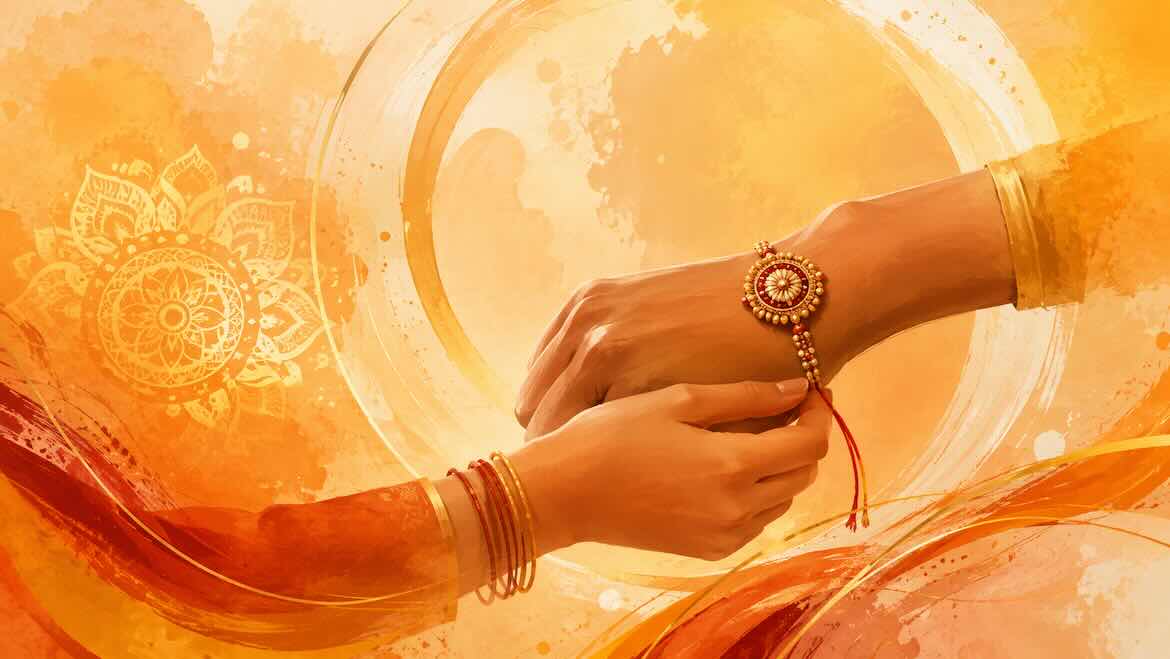
Raksha Bandhan is celebrated on Shravan Purnima, the full moon of the Hindu month of Shravan. A sister ties a rakhi, a sacred thread of protection, on her brother's wrist and prays for his well-being. The brother, in turn, promises to support and protect her.
But the festival is older and broader than the modern brother-sister ritual. Ancient texts describe the raksha-sutra as a protective thread used for kings and warriors, while later traditions gave it a strong association with siblings.
The Story
The most important scriptural reference is found in the Bhavishya Purana. In the Uttar Parva, Chapter 137, Krishna explains to Yudhishthira how a raksha-sutra should be prepared and tied on Shravan Purnima. The ritual involves a protective thread being tied by the royal priest, showing that Raksha Bandhan originally had a wider meaning of protection rather than being exclusively a brother-sister ceremony.
The famous mantra beginning "Yena baddho Bali Raja…" is also found here.
This links to a popular tradition that connects Raksha Bandhan with Lakshmi and King Bali. Goddess Lakshmi accepted Bali as her brother by tying a raksha-sutra on him and asked him to release Vishnu from his promise to remain in Bali's kingdom. This story emphasises that a rakhi can create a bond even between people who are not biological siblings.
Another popular account tells of Indra and Shachi (Indrani). Before a renewed battle between the devas and asuras, Shachi tied a protective thread on Indra. He subsequently regained victory. This story illustrates the rakhi as a symbol of blessings and protection.
The beloved story of Krishna and Draupadi says that Draupadi once tied a piece of cloth around Krishna's injured finger, and Krishna promised to protect her. However, the commonly told rakhi episode is not explicitly narrated in the Mahabharat. The Mahabharat does describe Draupadi calling upon Krishna for protection during the dice-hall episode in Sabha Parva.
There are other stories, such as Rani Karnavati and Humayun, but the association with the Raksha Bandhan episode is said to be doubtful because contemporary sources do not record it.
Did You Know?
In different parts of India, Shravan Purnima has other names and traditions. Maharashtra celebrates Narali Purnima, Odisha observes Gamha Purnima, and several communities perform sacred-thread or Upakarma rituals on the same day.
In 1905, Rabindranath Tagore encouraged people in Bengal to exchange rakhi threads as a symbol of unity while protesting the Partition of Bengal.
Why It Matters
Raksha Bandhan has evolved from the broader idea of a protective sacred bond into a celebration of family and responsibility. Its stories also show that raksha is not necessarily one-sided: the person offering protection may also receive love, loyalty, and strength in return.
That is why the festival continues to resonate across India and increasingly beyond biological brother-sister relationships.
References
- Bhavishya Purana
- Uttar Parva, Chapter 137: Description of Raksha Bandhan, the protective thread, its ritual, and the "Yena baddho Bali Raja…" mantra.
- Mahabharat
- Sabha Parva, Sections 66-67: Draupadi's appeal to Krishna for protection; the commonly told rakhi episode is a later traditional association rather than an explicit Mahabharata account.
- Bhagavat Purana
- Sarga 8: The Vaaman-Bali narrative underlying the later Lakshmi-Bali Raksha Bandhan tradition.