Quick Answer
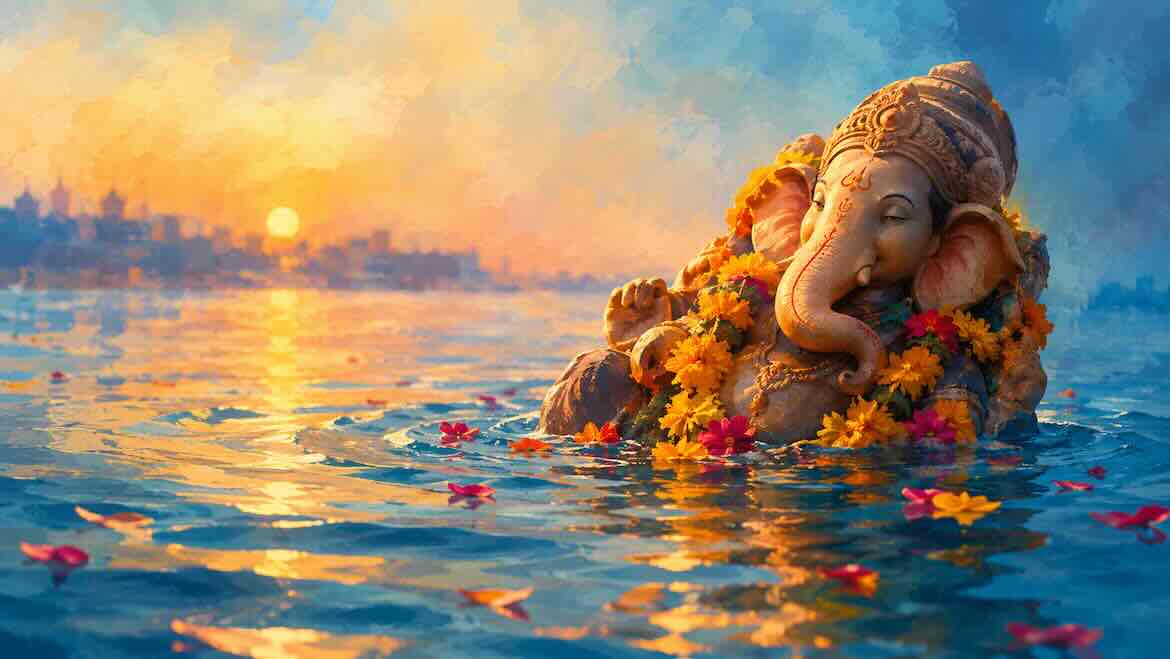
Ganesh idols are immersed in water as the concluding ritual of Ganesh Chaturthi. Traditionally, temporary idols were made from clay. After being worshipped for a chosen period, the idol is returned to water, symbolising the return of the physical form to nature and the completion of the festival.
The immersion is commonly performed on Anant Chaturdashi, the fourteenth day of the bright fortnight of Bhadrapad.
The Story
Ganesh Chaturthi begins with the installation and consecration of Lord Ganesh's murti. Traditional accounts describe Ganesh as the son of Shiva and Parvati, while later Puranic traditions give him an important place as the remover of obstacles and lord of the ganas. Texts such as the Skanda Purana and Agni Purana contain detailed procedures for worshipping Ganapati.
The festival, however, is not simply about keeping the idol permanently. The murti used for the festival represents a sacred presence for a particular period. After the worship is completed, devotees perform concluding rituals and take the idol for Visarjan, or immersion.
This creates a meaningful cycle: creation, worship, celebration and return. Clay, which comes from the earth, is shaped into the form of Ganesh and eventually dissolves back into water. The physical form is temporary, while devotion and remembrance continue.
There is an important historical distinction here. Ancient scriptures describe Ganapati worship and consecration, but the modern ten-day Ganesh festival followed by mass public Visarjan is a developed tradition rather than a single story prescribed in one ancient scripture. Family traditions may also immerse idols after one and a half, three, five, seven or eleven days.
Anant Chaturdashi is especially significant because it is itself an ancient observance dedicated to Anant, a form of Vishnu. The Narad Purana describes the Anant Chaturdashi vrata, including worship of Anant. Over time, in many regions, this day also became associated with the concluding immersion of Ganesh Chaturthi.
In Maharashtra, the public form of Ganeshotsav was significantly expanded in the late nineteenth century, particularly through Lokmanya Tilak's efforts in 1893.
Did You Know?
The traditional festival idol was made from clay, making its return to water especially meaningful. Today, many communities promote natural clay and non-toxic colours because plaster and chemical paints can harm water bodies.
Why It Matters
Visarjan teaches a simple lesson: do not mistake the physical form for the whole of what is sacred. We may create something beautiful, become attached to it, and eventually have to let it go.
Ganesh Visarjan turns that difficult truth into a celebration. The idol returns to nature, while the qualities associated with Ganesh, such as wisdom, humility, perseverance and the removal of obstacles, are meant to remain in our lives.
References
- Skanda Purana, Nagara-khanda, Chapter 214, Procedure of Ganapati Worship.
- Agni Purana, Chapter 318, The Mode of Worshipping Ganapati.
- Agni Purana, Chapter 71, Mode of Worshipping Ganapati.
- Narada Purana, Chapter 123, description of the Ananta Chaturdashi Vrata.
- Ganapati Atharvashirsha, traditional Upanishadic text associated with Ganapati worship.