Quick Answer
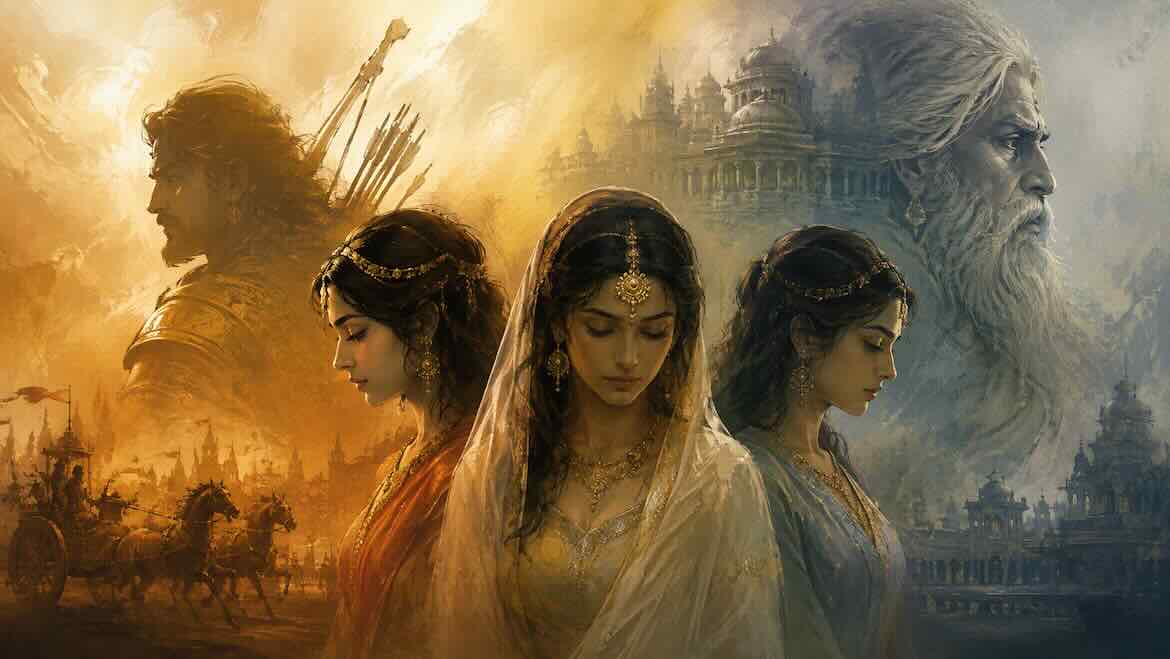
Amba, Ambika, and Ambalika were the three daughters of the King of Kashi. Bhishma carried them away from their svayamvara to marry them to his younger half-brother, Vichitravirya. While Ambika and Ambalika became queens of Hastinapur, Amba's life took a tragic turn after she was separated from the man she loved. Her determination to avenge her humiliation eventually became connected with Bhishma's fall in the Kurukshetra war.
The Story
The three princesses were daughters of the King of Kashi and sisters born into a powerful royal family. When their svayamvara was arranged, princes and kings from several kingdoms gathered to seek their hands in marriage.
Bhishma, however, arrived with a different purpose. Vichitravirya, the younger son of Shantanu and Satyavati, was the Kuru king but needed queens to continue the dynasty. Bhishma challenged the assembled rulers, defeated them, and carried away all three princesses to Hastinapur for Vichitravirya.
At Hastinapur, Amba revealed that she had already chosen King Shalva in her heart and intended to marry him at the svayamvara. Bhishma accepted her statement and allowed her to leave for Shalva. But Shalva rejected Amba, arguing that Bhishma had defeated him and taken her away. Amba then returned to Bhishma, but he could not marry her because of his lifelong vow of celibacy.
Amba eventually turned her anger towards Bhishma. She sought the help of Parashuram, who had once been Bhishma's teacher. Parashuram challenged Bhishma to battle, but their great duel ended without a decisive victory. Amba continued her austerities and resolved to become the cause of Bhishma's death. She was later reborn as Shikhandi, who played a crucial role in Bhishma's fall at Kurukshetra.
Meanwhile, Ambika and Ambalika married Vichitravirya. Their marriage lasted only a few years, as Vichitravirya died of illness without fathering an heir.
To preserve the Kuru lineage, Satyavati asked her firstborn son, Vyas, to father children with the widowed queens according to the custom of niyoga.
Thus, the three sisters became connected to two major threads of the Mahabharat: Amba's conflict with Bhishma and the lineage that eventually led to the Kurukshetra war.
Did You Know?
- Amba was the eldest of the three sisters.
- Ambika became the mother of Dhritarashtra, father of the Kauravas.
- Ambalika became the mother of Pandu, father of the Pandavas.
Why It Matters Today
Their story reminds us that personal choices and powerful institutions can affect generations. It also shows why the Mahabharat is more than a story of war. It explores difficult questions about duty, consent, honour, justice, and the consequences of decisions.
References
- Mahabharat
- Adi Parva, Sambhava Parva, Sections 102-103: The abduction of the three Kashi princesses, Amba's relationship with Shalva, the marriages of Ambika and Ambalika, and Vichitravirya's death.
- Udyoga Parva, Ambopakhyana sections: Amba's subsequent austerities, her quest against Bhishma, and the events leading toward her rebirth as Shikhandi.