Quick Answer
Janamejaya, the son of King Parikshit, performed the Sarpa Satra (snake sacrifice) to destroy all serpents after his father died from a snake bite caused by Takshak, the king of serpents. The sacrifice was stopped by the young sage Astik, who requested Janamejaya to end the ritual and choose forgiveness over revenge.
The Story
The story appears in the Adi Parva of the Mahabharat. King Parikshit, the grandson of Arjun, was cursed to die from a snakebite after an unfortunate incident involving a sage. Despite attempts to protect him, the serpent king Takshak reached Parikshit and caused his death.
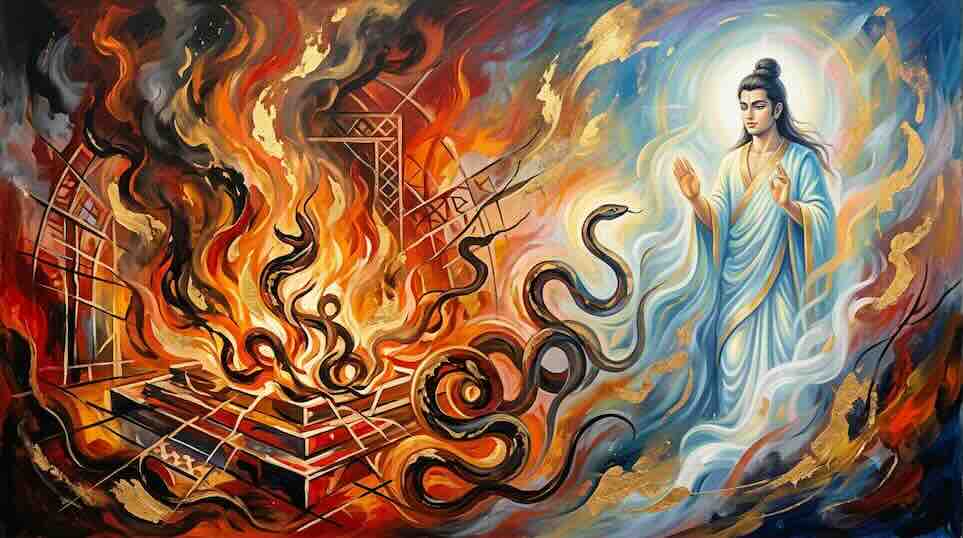
After becoming king, Janamejaya was filled with sorrow and anger. To avenge his father's death, he organised a powerful fire ritual known as the Sarpa Satra, where sages chanted mantras that caused snakes to be pulled into the sacrificial fire.
The ritual became so powerful that even Takshak was drawn towards it. Fearing the destruction of all serpents, the sages and divine beings sought a way to stop the sacrifice.
At that moment, Astik, a young and highly learned sage, arrived at the sacrificial ceremony. Astik's father was a sage and his mother, Jaratkaru, belonged to the lineage of serpents (Nagas). Because of this heritage, Astik understood the fears and suffering of the serpent community while also being rooted in the wisdom of the sages.
When Astik reached the Sarpa Satra, he did not challenge the king with anger or force. Instead, he approached Janamejaya with humility and praised the king's virtues and knowledge. His calm words and deep understanding impressed the assembled sages and the king himself.
Pleased with Astik's wisdom, Janamejaya offered him a boon, as was the custom during great sacrifices. Astik then requested the king to stop the Sarpa Satra and spare the remaining serpents, including Takshak.
The king was caught between his desire for revenge and his promise to grant the sage's wish. However, bound by his word and recognising the righteousness behind Astik's request, Janamejaya accepted it and ordered the sacrifice to end.
Through Astik's wisdom, the cycle of revenge was brought to a halt. His intervention did not erase the pain of Parikshit's death, but it prevented that pain from turning into the complete destruction of an entire race.
Did You Know?
- The Sarpa Satra is also connected with the narration of the Mahabharat itself. Sage Vaishampayan, a disciple of Sage Vyas, recited the Mahabharat to King Janamejaya during this gathering.
- Through these dialogues, Janamejaya learned about the greatness and struggles of his ancestors, including the choices, mistakes, sacrifices, and moral dilemmas faced by the Pandavas and Kauravas.
- The festival of Nag Panchami is traditionally associated with reverence towards snakes, though its origins involve multiple cultural traditions across India. The story of Astik is one of the important narratives connected with serpent worship traditions.
Why It Matters Today
The story of Janamejaya and Astik reflects an important idea of Indian thought: dharma requires balance. While seeking justice after a loss is natural, uncontrolled anger can lead to actions that create greater harm.
Astik's wisdom shows that courage is not always found in confrontation; sometimes it is found in preventing unnecessary destruction. The story continues to inspire discussions about forgiveness and the consequences of revenge.
References
- Mahabharat
- Adi Parva, sections describing Janamejaya's Sarpa Satra, Astik's birth, and the stopping of the snake sacrifice.
- Adi Parva, the account of King Parikshit's death and Janamejaya's desire for revenge.
- Vishnu Purana
- Book 4, references to genealogies of kings including Parikshit and Janamejaya.
- Bhagavat Purana
- Skandha 1, chapters describing King Parikshit's life and death.