Quick Answer
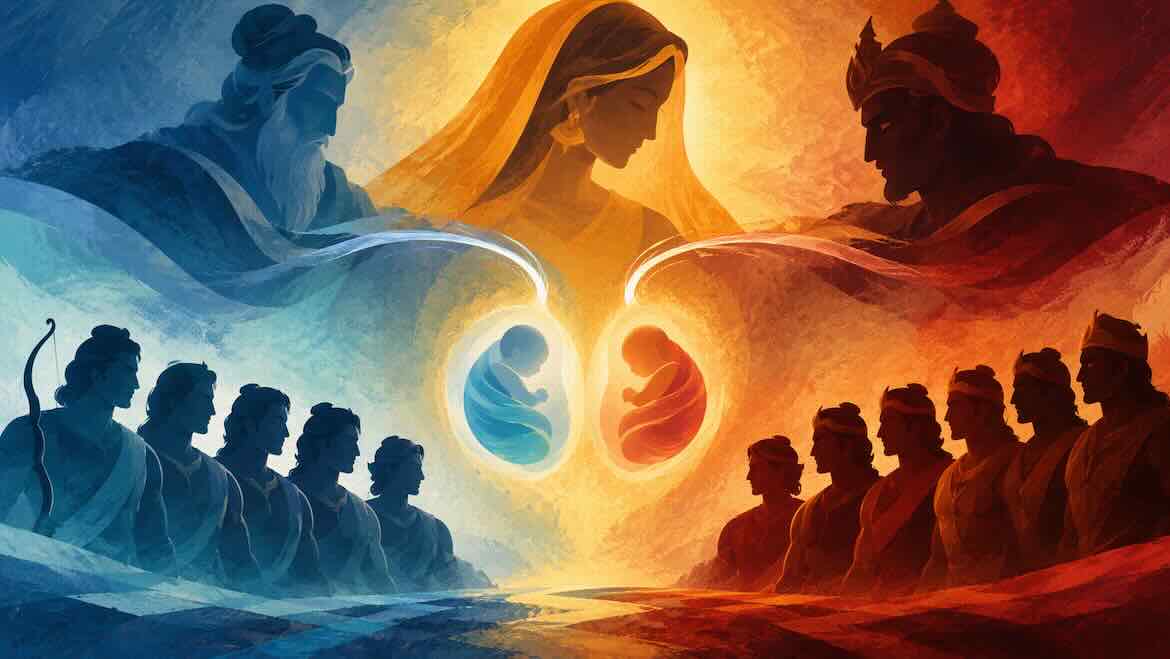
The five Pandavas were born to Kunti and Madri through divine intervention, while the hundred Kauravas were born to Gandhari through an extraordinary process described in the Mahabharat.
Pandu, father of the Pandavas, had been cursed that he would die if he approached his wives with desire. Kunti therefore used a sacred mantra given to her by Sage Durvasa to invoke divine beings.
The Kauravas had a very different beginning. Gandhari had received a boon that she would have a hundred sons.
The Story
Gandhari was the wife of Dhritarashtra, the elder prince of the Kuru dynasty. She had received a remarkable boon from Sage Vyas. One day, when Vyas arrived at her home exhausted and hungry, Gandhari welcomed him and served him with great respect. Pleased with her hospitality, Vyas granted her the boon she requested: she would have one hundred sons, each equal to her husband Dhritarashtra in strength and accomplishments.
Gandhari eventually conceived, but her pregnancy continued for two long years without a child being born. She became deeply distressed. Then she heard that Kunti had already given birth to Yudhishthir. Overcome by grief and impatience, Gandhari struck her womb without Dhritarashtra's knowledge.
Instead of a child, a hard mass of flesh, resembling an iron ball, came out of her womb. Gandhari was about to throw it away when Vyas arrived. He told her that his words could never be false and instructed her to bring one hundred pots filled with clarified butter. The mass of flesh was sprinkled with cool water and gradually divided into one hundred and one pieces, each about the size of a thumb. These pieces were placed separately into the pots filled with clarified butter and carefully guarded. Vyas instructed Gandhari to open the pots after two years.
The first child born from these pots was Duryodhan, followed by his ninety-nine brothers. An additional portion became their sister, Duhshala. Dhritarashtra also had another son, Yuyutsu, who was born to a Vaishya woman and was therefore not one of Gandhari's hundred sons.
Meanwhile, Pandu lived in the forest with his two wives, Kunti and Madri. Pandu had been cursed that he would die if he approached his wives with desire. Kunti therefore used a sacred mantra given to her by Sage Durvasa, which allowed her to invoke a deity and receive a child.
At Pandu's request, Kunti first invoked Dharma, and Yudhishthir was born. She then invoked Vayu, giving birth to the immensely strong Bhima. Later, she invoked Indra, and Arjun was born.
Madri was still without a child. Kunti shared the mantra with her, and Madri invoked the Ashvin twins. She consequently gave birth to the twins Nakul and Sahadev.
Thus, the five Pandavas were born to Kunti and Madri through divine intervention, while Gandhari became the mother of the hundred Kaurava brothers and their sister Duhshala.
Did You Know?
- Kunti had received the divine-invocation mantra from Sage Durvasa before her marriage to Pandu.
- Yudhishthir was born before Duryodhana, although their births were very close in the story.
- Bhima and Duryodhan were born on the same day.
Why It Matters Today
The birth stories remind us that people can begin life within the same family yet follow very different paths.
The Mahabharat repeatedly shows that birth and privilege do not by themselves determine a person's character. Choices and actions gradually shape what follows.
References
- Mahabharat
- Adi Parva, Sambhava Parva: Sections 111, 115-116 and 122-124, covering Kunti's mantra, Gandhari's unusual pregnancy and the births of the Pandavas and Kauravas.