
Contemporary Fiction Corporate Fiction Technology Slice of Life

Gurgaon Code

A Day of a Software Engineer;

"One long day. Full stack of incidents."

A sharp, emotionally grounded corporate drama set entirely within the rhythm of one tense day. Explore the unseen emotional labor, office politics, and deadlines that define the tech workspace in modern India.

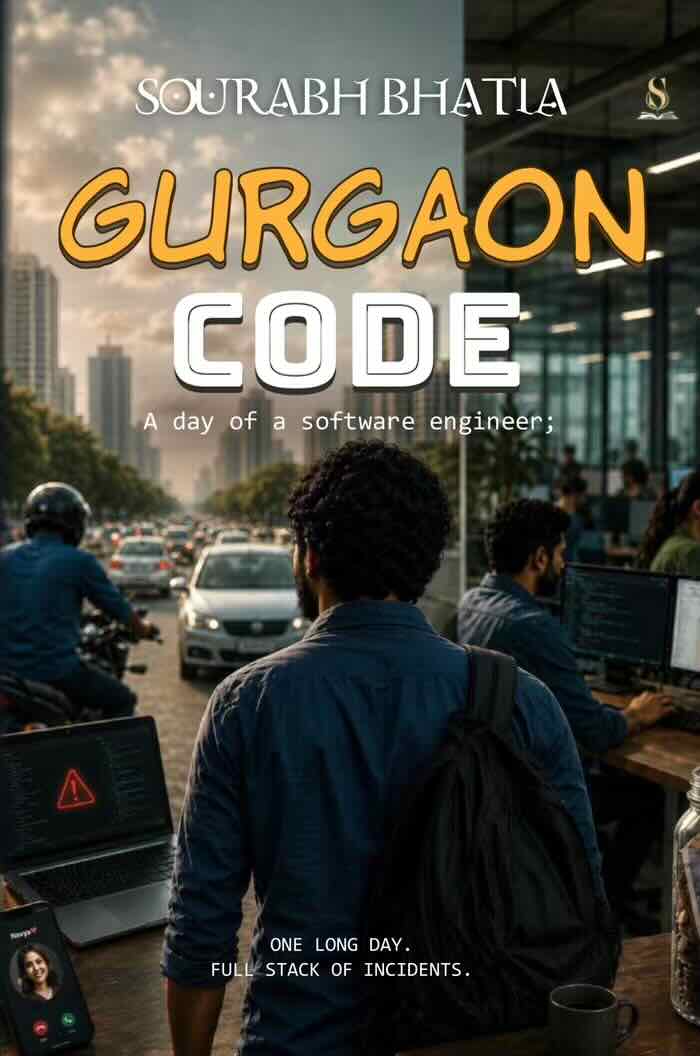
Front cover of Gurgaon Code novel showing high-rise office towers
Front Cover
Back cover placeholder
Back Cover

Before You Read

Every software engineer in India has lived this story. Before you open the first page of Gurgaon Code, let's establish what this novel is, and what it represents.

  • This isn't a thriller about cyber conspiracies.
  • This isn't a startup success story filled with VC funding clichés.
  • This isn't a tale of billion-dollar founders and instant wealth.
  • It is the story of one ordinary workday that mirrors the struggles, jokes, and dreams of millions of software developers in India.

At a Glance

Title Gurgaon Code
Author Sourabh Bhatia
ISBN 978-93591-2257-1
Genre Contemporary / Corporate Fiction
Setting Gurgaon, India
Timeline One unforgettable workday.
Language English
Formats Paperback, Kindle
Reading Time Approx. 4-5 hours
Themes Burnout, Office Politics, Friendship
Status Available Now

About the Novel

In the bustling maze of Gurgaon, a senior software developer juggles the relentless rhythm of corporate life, personal ambitions, and the invisible weight of impending adulthood. The novel unfolds over the course of a single ordinary day, capturing the protagonist's inner world as he grapples with alarms, deadlines, and the fragile balance between responsibility and desire.

The day begins with the alarm clock's endless snooze cycle, a roommate's quiet betrayal, and the looming threat of a punctuality fine. Racing against time, he navigates the city's unpredictable traffic on his Pulsar, dodging honking cars, chaotic intersections, and the menacing SUV that threatens to escalate from a bumper tap to a near-street confrontation with metal rods. Gurgaon's mornings are a battlefield of vehicles and patience, and he enters the office already marked by adrenaline and fatigue.

Within the glass walls of his IT company, the protagonist's life narrows to stand-up meetings, Jira boards, and the dreaded P1 production bug, an intermittent statement download error that refuses to reveal its secrets. As he wrestles with logs and timeouts, his personal life intrudes softly through calls from his mother and fiancée, Navya, pulling him into conversations about breakfast, savings, and the looming wedding. These interactions weave warmth and humour into the monotony, grounding him against the day's escalating chaos.

The story pulses between the mundane and the dramatic. Corporate rituals, like dropping fines in the Punctuality Improvement Fund jar, attending an account townhall with veiled threats about performance and compensation, and sharing greasy aloo parathas and weak tea in the food court, sit alongside moments of tension, like the prank emails that throw his job into jeopardy. A careless lapse of leaving his laptop unlocked spirals into an internal security investigation when a mischievous fresher sends a snack-sponsorship email to the entire floor and a scathing, career-threatening message to the client. The protagonist is forced to confront responsibility, vulnerability, and the thin line between humour and disaster in office life.

As the day stretches, small victories and personal revelations emerge. He identifies the pattern behind the elusive P1 bug, refactors code, collaborates with QA, and steadies the team's faith in him. The evening culminates in an ahata, a modest BYOB courtyard where three friends share soft drinks, whisky, and malai chaap under fairy lights. Here, amid laughter and confessions, the protagonist feels a fragile sense of reprieve from a day that has threatened his career, finances, and composure.

Conversations peel back layers of shared struggle: Vivek's secret job offer held hostage by a background verification due to a long-buried college FIR, and Ankit's raw story of four failed UPSC attempts, the weight of loans, and the dignity of choosing stability over unfinished dreams. The novel balances the humour of office banter with the gravity of invisible battles, such as loans, aspirations, and the unspoken emotional labour of surviving in a city that measures worth in salaries and square feet.

Still, the narrative refuses to settle into comfort. A final twist arrives when two men join their table, reminding the protagonist that life outside the corporate bubble is equally precarious and unpredictable.

The novel blends slice-of-life realism with slow-building tension, exploring themes of responsibility, aspiration, vulnerability, and the heroism of ordinary days in the lives of young professionals.

Inside This Story

Corporate Chaos

Navigating complex hierarchies, constant client demands, and shifting business priorities.

Morning Traffic

The daily battle on Gurgaon's roads, battling dust and deadlines on a Pulsar.

Stand-up Meetings

The daily 15-minute updates where developers try to sound busy on the Jira board.

Production Bugs

The high-pressure search for errors in real-time when the system is down.

Deadlines

The invisible timelines that govern weekends, evenings, and personal plans.

Friendship

The shared jokes and terrace smoke breaks that make corporate survival possible.

Marriage & Family

Balancing parental expectations, arrange-marriage profiles, and home loans.

Career Anxiety

The fear of falling behind in tech stacks, appraisal ratings, and salary hikes.

Meet the Characters

💻

The Protagonist

A mid-level developer trying to balance production bugs against office pressures, family responsibilities, and the city itself.

👩‍💻

Navya

A senior developer carrying the weight of complex legacy systems and code reviews.

👔

Ajit

The engineering manager caught between client demands and team burnout.

🏠

Vivek

The flatmate of the protagonist, working in a different team.

🔍

Diksha

The QA Engineer whose approval is required before code is released to production.

🧑‍🎓

Kartik

The fresh graduate trying to find his footing amidst technical terms and Jira boards.

📞

The Client

The distant, demanding stakeholder whose escalations drive the team's schedule.

🕵️

IT Security

The investigator checking access logs, adding tension to an already long day.

A Day in Gurgaon

Alarm 09:33 AM
Traffic 10:00 AM
Stand-up 10:30 AM
P1 Bug 11:30 AM
Lunch 01:00 PM
Townhall 02:00 PM
Security Incident 04:40 PM
Bug Fix 06:00 PM
BYOB Night 08:30 PM
The Twist 09:33 PM

Core Themes

Corporate Pressure

The psychological impact of endless sprints, reviews, and client calls.

Identity & Tech

Finding meaning when your daily life is governed by tickets and logs.

Friendship

How shared support networks provide relief in high-pressure workspaces.

Burnout

The gradual physical and emotional wear of the corporate IT environment.

Who Will Relate to This Book?

You work in IT.

You understand Stand-ups, Code reviews, and the dread of appraisal seasons.

You have fixed production bugs.

You know the stress when logs are printing errors and the team is waiting.

You support your family.

You balance home loans and personal responsibilities against corporate life.

You dream of work-life balance.

You feel nobody understands what software developers actually face day-to-day.

Corporate Glossary

A quick guide to the terminology of modern software engineering and agile corporate life in India:

Jira A project tracking tool used to assign tasks and trace developer output.
Sprint A fixed period of time (usually 2 weeks) during which specific tasks must be completed.
Stand-up Meeting A daily 15-minute status update meeting for Agile development teams.
P1 Incident A critical production outage requiring immediate resolution from support teams.
Technical Debt The cost of choosing quick code fixes now over clean design paths later.
CI/CD Continuous Integration/Continuous Deployment channels to build and test code.

Frequently Asked Questions

Although Gurgaon Code is a work of fiction, the corporate settings, Agile rituals, and developer terminologies are inspired by the author's decade-long experience inside the Indian software industry.
Not at all. While software developers will immediately recognize their daily struggles, any corporate professional who has dealt with office politics, deadlines, demanding clients, or burnout will relate to the story.
Yes. The focus is on the human relationships, office politics, marriage pressures, and personal dreams of the characters rather than dry technical jargon.
By compressing the timeline into one 24-hour cycle, the book captures the intense pressure, rapid transitions, and fast-paced environment of a typical corporate workday in Gurgaon.
It explores realistic relationship dynamics, including the pressures of finding a partner, coordinating marriage expectations, and maintaining work-life balance inside the high-stress IT sector.
Yes, it features sharp office humor and dry wit reflecting the coping mechanisms developers use to survive stand-ups, townhalls, and buggy deployments.
Yes, office politics, appraisal anxieties, credit-grabbing managers, and the delicate art of team dynamics form a core part of the plot.
Absolutely. Senior developers and leads will highly relate to the P1 bugs, production support stress, and code reviews, while managers will recognize the balancing act between client demands and team burnout.
Yes, it offers a realistic, unvarnished look at what awaits freshers entering the corporate tech space in India, preparing them for office dynamics beyond textbook coding.
Gurgaon is the perfect microcosm of modern corporate India, representing the contrast between ultra-modern glass offices, massive tech parks, traffic jams, and middle-class aspirations.
Extremely realistic. The Agile rituals, Jira tickets, client escalations, and lunchroom talks are written from years of direct observation in enterprise software setups.

Bring Gurgaon Code to Your Shelf

Available in paperback in India and in digital format internationally.

Stay in the Circle

If stories about technology, work, and modern India resonate with you, subscribe for future books and articles.

Join the newsletter